Assalamualaikum wbt brothers and sisters. Here are a list of new members of the team for the Mission to Xian 2008. Details are soon to be finalized.
1. abadi
2. intan
3. maryam
4. yi pinn
5. harith
6. faridah
7. jihan
8. nabeela azmi
Congratulations to the new members.
Please let yourself known to the mission secretary, Hani Zakaria (email: hani2404@yahoo.com). Include your details: name, university, address, telephone numbers.
Your email addresses will be registered to the mission2china Yahoo Group for further updates.
Thank you.
M2X 2008 Team


Sunday, 11 May 2008

Monday, 5 May 2008
UPDATED M2X Budget!
Assalamualaikum wbt,
Congratulations to the team members that has been working hard in getting sponsorships.
Unfortunately, due to the Beijing Olympic season and addition of new team members (which will be finalised by 14th of May) ,the budget has been revisited.
Finalized amount needed for this mission is €3000, therefore total sponsorship needed is RM 14,685.4
collected so far: €1954 (RM 9,566.10)
amount to go: € 1046 (RM 5,119)
...every little helps...
much regards,
M2X Team
Congratulations to the team members that has been working hard in getting sponsorships.
Unfortunately, due to the Beijing Olympic season and addition of new team members (which will be finalised by 14th of May) ,the budget has been revisited.
Finalized amount needed for this mission is €3000, therefore total sponsorship needed is RM 14,685.4
collected so far: €1954 (RM 9,566.10)
amount to go: € 1046 (RM 5,119)
...every little helps...
much regards,
M2X Team
Friday, 2 May 2008
Wednesday, 30 April 2008
Promo Poster

The estimated budget for this mission is €2000,
therefore total sponsorship needed is RM 9693.77.
amount collected so far: €1380
amount still needed: €620 (RM 3005.07)
...every little helps...
much regards,
Mission To China 2008 Team
therefore total sponsorship needed is RM 9693.77.
amount collected so far: €1380
amount still needed: €620 (RM 3005.07)
...every little helps...
much regards,
Mission To China 2008 Team
Thursday, 17 April 2008
CONDITION FOR APPLICANTS & PROGRAM TENTATIVE
Due to massive applications, we have come to a conclusion to set NEW condition in your applications.
It is COMPULSORY that you include an essay (100 words) describing yourself.
Please send in your essays before the 30th of April 2008.
Send them to:
MUHAMMAD NAJMI NADZIR
PROJECT MANAGER
MISSION TO CHINA 2008
jermz002@yahoo.com
+353 85712 6664
TENTATIVE (Subject to changes)
12/07/2008 Day 1 Arrive at Beijing - Get train to Xian
13/07/2008 Day 2 Depart from Xian to Tian Shui
- Meeting people in China at Tian Shui
- Briefing on activities for the whole mission
- Work delegation according to proposed plan
- Presentation and talks e.g dental care demonstration
- Distribution of donations eg drugs, formulated milk, food and dental care products according to villages
14/07/2008 Day 3 Mobile clinic and education about health and hygiene at first village
- Registration
- Set up booth for mobile clinics carried out by student volunteers with help of villagers.
- Consultation with the doctors and prescribing medication
- Promotion and inform on hygiene to villagers
15/07/2008 Day 4 Mobile clinic and education about health and hygiene at first village Registration
- Set up booth for mobile clinics carried out by student volunteers with help of villagers.
- Consultation with the doctors and prescribing medication
- Promotion and inform on hygiene to villagers
16/07/2008 Day 5 Session with villagers in 2nd village (evening)
Depart to Tian Shu
- Traditional games with the villagers
- Consultation and home help
- Distribution of donation
- Colouring competition among the China children
- Quran recitation competition
17/07/2008 Day 6 Depart to Xian and from Xian to Beijing
18/07/2007 –
19/07/2007 Day 7 & 8 Tour Beijing
20/07/2008 Day 9 Departure back to Malaysia
It is COMPULSORY that you include an essay (100 words) describing yourself.
Please send in your essays before the 30th of April 2008.
Send them to:
MUHAMMAD NAJMI NADZIR
PROJECT MANAGER
MISSION TO CHINA 2008
jermz002@yahoo.com
+353 85712 6664
TENTATIVE (Subject to changes)
12/07/2008 Day 1 Arrive at Beijing - Get train to Xian
13/07/2008 Day 2 Depart from Xian to Tian Shui
- Meeting people in China at Tian Shui
- Briefing on activities for the whole mission
- Work delegation according to proposed plan
- Presentation and talks e.g dental care demonstration
- Distribution of donations eg drugs, formulated milk, food and dental care products according to villages
14/07/2008 Day 3 Mobile clinic and education about health and hygiene at first village
- Registration
- Set up booth for mobile clinics carried out by student volunteers with help of villagers.
- Consultation with the doctors and prescribing medication
- Promotion and inform on hygiene to villagers
15/07/2008 Day 4 Mobile clinic and education about health and hygiene at first village Registration
- Set up booth for mobile clinics carried out by student volunteers with help of villagers.
- Consultation with the doctors and prescribing medication
- Promotion and inform on hygiene to villagers
16/07/2008 Day 5 Session with villagers in 2nd village (evening)
Depart to Tian Shu
- Traditional games with the villagers
- Consultation and home help
- Distribution of donation
- Colouring competition among the China children
- Quran recitation competition
17/07/2008 Day 6 Depart to Xian and from Xian to Beijing
18/07/2007 –
19/07/2007 Day 7 & 8 Tour Beijing
20/07/2008 Day 9 Departure back to Malaysia
Wednesday, 16 April 2008
OUR MISSION - in brief
PPIMI & PMC ISLAMIC SOCIETY aspires to broaden the scope of activities to serve Muslim welfare at international scale. We have chosen China for this year’s mission as for its abundance of historical ties to our country Malaysia. According to history, the Malays are the descendants of the Yunnans and hopefully we would learn more of the history and culture of our forgotten roots.
The extraordinary Chinese traders have also played a prominent role in the spreading of Islam in the Malay Archipelago since the early 15th century. The active preaching of Islam during the Sultanate of Malacca has bore more than 13 million Muslims in Malaysia today with Malays being the majority. China has more than 30 million Muslim populations in which their existence has been relatively unknown to their Chinese counterparts in Malaysia.
We do hope that this mission will help to show that there are also Chinese that are muslims other than Malay muslims, a typical stereotype view in Malaysia that clearly diminishes the fact that Islam is a religion not based on race, ethnic or skin colour. With the marked history of Islam arrival in China as early as 7th century during the Caliph Uthman al Affan reign, Islam covers 10 nationalities and was heralded as the Race in China during the Republic of China formation in 1911. PPIMI and Penang Medical College Islamic Society (PMC ISOC) in collaboration with China Muslim Silaturrahim agree to that sufficient education and facilities access must be pursued to enable the communities develop their potential capabilities to improve their society. Therefore, this mission aims to equip more educational and welfare facilities in the Xian community especially in mosque, kindergartens, schools and orphanages since Xian has a big population of Chinese Muslim..
PPIMI also aims to arrange medical consultations with the help from Yayasan Amal to entitle the population with free and direct health care service and to conduct round table discussion to allow discussions especially on how to reinforce the community with the limited resources available.
PROPOSED PLAN OF ACTIVITIES
Fund-raising and donation drive
- Donation drives in United Kingdom, Ireland, Russia and Malaysia in conjunction with Penang Medical College (PMC) to collect money and required items.
- Approaching individuals, companies and organizations for sponsorship.
Preparation training
- Courses for student volunteers with Yayasan Amal doctors in first aid, emergency medicine, psychology and post-trauma psychiatry.
- Short courses on Chinese history, culture and tradition, and Mandarin language.
Project in China
The team will set up a place to act as the base of our relief work and mobile clinic. The proposed activities are divided into two aspects: Medical and Social Relief
MEDICAL RELIEF
Population survey
i. Make an observation of the local population and situation for further management of the project
ii. Make adjustment to proposed activities to cater to the needs of target groups and time
iii. Hold a meeting and finalise delegation of work to all volunteers
iv. Brief volunteers on execution of the final plan
Medical
- Mobile clinic: this clinic offers free consultation to local population in the proximity which will cater for a range of health problems including common illnesses, chronic disease (e.g. diabetes mellitus, hypertension) and malnutrition.
- Medical check up and treatment -Blood pressure,Body temperature,Height,Weight,Pulse rate,Cardiovascular examination.
- Antenatal advice and paediatric care
- To distribute available medications (provided by the team under the advised by the local health authorities) to those in need (eg. antibiotics, vitamins and healthcare products).
- To assist doctors in minor surgeries eg circumcisions, trauma and labour
Educational
- Informal education by each volunteer to local population throughout all activities in the project.
- To give out relevant brochures and educational pamphlets
SOCIAL RELIEF
Donations
Distribute donation at our base in the form of:
Blanket and clothes
Food and formulated milk
Self care and dental care products
Books (including religious materials), school bags and stationeries
Health supplement (e.g vitamins)
Community work
- Home visit for villagers unable to access the mobile clinic to distribute donation and help out with domestic errands i.e. cleaning
- Visit children in local schools and set up a basic “English Classes”
DETAILS FOR SPONSORSHIP
Account Name : NURHANIS SYAZNI ROSLAN
Bank : Allied Irish Bank, 1 Lower Baggot Street, Dublin 2.
Sort Code : 931012
Account Number: 70737186
IBAN : IE43 AIBK 9310 1270 7371 86
BIC : AIBKIE2D
Bank : Allied Irish Bank, 1 Lower Baggot Street, Dublin 2.
Sort Code : 931012
Account Number: 70737186
IBAN : IE43 AIBK 9310 1270 7371 86
BIC : AIBKIE2D
Thursday, 10 April 2008
History of Islam in China
China is home to a large population of practitioners of Islam. Sources, including the BBC, suggest that there may be as many as 20 million Muslims in China, up to 2% of the country's 1.3 billion population. Other sources suggest Muslims in China number more than 30 million.
The biggest titular Muslim ethnic group in China is the Hui, while others include the Uyghurs and the Kazakhs. The largest concentration is found in China's northwestern Xinjiang autonomous region.
A unique feature of some modern Muslim practitioners in China is the presence of female imams.
During the Tang Dynasty, China was highly tolerant of new religions and Chinese contact with foreign envoys flourished. Islam was introduced to China via the silk road by Arabs. Although some believe that Islam may have arrived in China during the Sui Dynasty, the first official record of Islam's arrival in China occurred during the Tang Dynasty.
Uthman ibn Affan, the third Caliph of Ummah, sent the first official Muslim envoy to China in 650. The envoy, headed by Sa'ad ibn Waqqas, arrived in the Tang capital, Chang'an, in 651 via the overseas route. Huis generally consider this date to be the official founding of Islam in China. The Ancient Record of the Tang Dynasty recorded the historic meeting, where the envoy greeted Emperor Gaozong of Tang China and tried to convert him to Islam. Although the envoy failed to convince the Emperor to embrace Islam, the Emperor allowed the envoy to proselytize in China and ordered the establishment of the first Chinese mosque in the capital to show his respect for the religion.
Arab people are first noted in Chinese written records, under the name Da shi in the annals of the Tang dynasty (618-907). Records dating from 713 speak of the arrival of a Da shi ambassador. It is recorded that in 758, a large Muslim settled in Guangzhou erupted in unrest and fled. The community had constructed a large mosque (Huaisheng Si), destroyed by fire in 1314, and constructed in 1349-51; only ruins of a tower remain from the first building.
During the Tang Dynasty, a steady stream of Arab and Persian traders arrived in China through the silk road and the overseas route through the port of Quanzhou. Not all of the immigrants were Muslims, but many of those who stayed formed the basis of the Chinese Muslim population and the Hui ethnic group. The Arab and Persian immigrants introduced polo, their cuisine, their musical instruments, and their knowledge of medicine to China.
During the Song Dynasty, Muslims in China dominated foreign trade to the south and west.
The Yuan Dynasty embraced Islam. The Mongols elevated the status of Muslims versus the Chinese, and placed many Muslims in high-ranking posts instead of Confucian scholars, relying on Muslims to administer the empire. The state encouraged Muslim immigration, as Arab, Persian and Turkic immigration into China accelerated during this period.
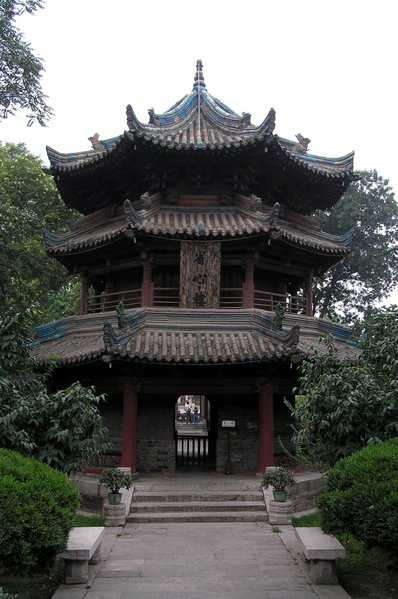
Chinese-style minaret of the Great Mosque (Xian, China)
Muslims continued to flourish in China during the Ming Dynasty. During Ming rule, the capital, Nanjing, was a center of Islamic learning.
Mosques in Nanjing are noted in two inscriptions from the sixteenth century.
Immigration slowed down drastically however, and the Muslims in China became increasingly isolated from the rest of the Islamic world, gradually becoming more sinicized, adopting the Chinese language and Chinese dress. During this period, Muslims also began to adopt Chinese surnames. One of the more popular Muslim family names is Ma (馬), a shortened form of Fatima.
Muslims suffered a decline of their status during the Qing Dynasty. Numerous Hui rebellions, such as the Panthay Rebellion, sprung up during the Qing Dynasty in reaction to repressionist policies.
In the first decade of the 20th century, it has been estimated that there were between 50 million and 3 million Muslims in China proper (that is, China excluding the regions of Mongolia and Xinjiang), with the true number probably lying closer to 20,000,000 or 30,000,000. Of these, almost half resided in Gansu, over a third in Shaanxi (as defined at that time) and the rest in Yunnan.
In the Qing dynasty, Muslims had many mosques in the large cities, with particularly important ones in Beijing, Xi'an, Hangzhou, Guangzhou, and other places (in addition to those in the western Muslim religions). The architecture typically employed traditional Chinese styles, with Arabic-language inscriptions being the chief distinguishing feature. Many Muslims held government positions, including positions of importance, particularly in the army.
Some Chinese Muslims may have made the Hajj pilgrimage to Mecca on the Arabian peninsula between the fifteenth and eighteenth centuries, yet there is no written record of this prior to 1861, it has been asserted.
Subscribe to:
Posts (Atom)
